Which narratives and interventions by development cooperation are effective for democracy support? Under which conditions do social groups defect and mobilize under autocracies? These questions run through this portfolio. I study the effectiveness of European framing of democracy support, and why it has been ineffective at best, as well as the structural conditions working against elite defection in cases of highly polarized, incumbent-led autocratization.
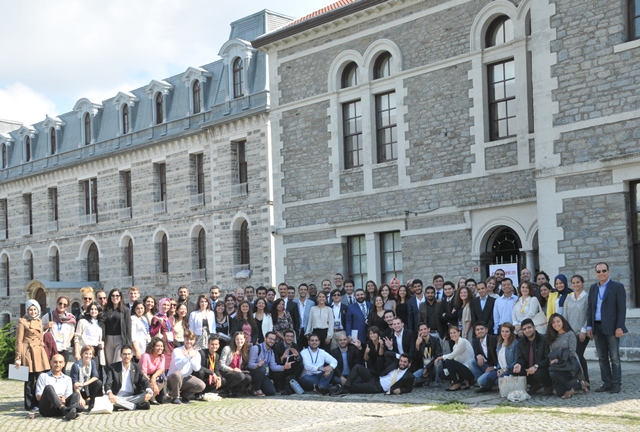
The network mobilized more than 30 stakeholders in six countries across the MENA region, built cross-sectoral collaboration with NGOs, business associations, and research institutes for inclusive economies, good governance, and youth mobilization in the age of the Fourth Industrial Revolution, and organized summits and capacity development programs in Belgium, Italy, Lebanon, Morocco, Tunisia, and Turkey.
Link here →The nature of democracy support has shifted. Is there a role for international and development cooperation in democracy support? Which narratives and interventions are effective?
It is possible to communicate strategic interests with transparency, while still remaining anchored in global values.
Existing explanations for the opposition's success in Hungary are after the fact and secondary. Without Magyar's legal immunity and financial mobilization, this victory would have been impossible.
Democracy promotion as we know it is likely finished. The global wave of autocratisation has fundamentally altered the landscape, rendering traditional approaches to democracy promotion largely ineffective and unsustainable. The logic of democracy promotion has reversed: during the Third Wave of Democratisation, the aim was to work with the tide of democratisation; today it works "against the tide" of autocratisation. That is why democracy aid should aim for protection instead of promotion. Despite evidence suggesting that democracy aid has worked against autocratisation, significant empirical gaps remain regarding which specific approaches are most effective. This effectiveness depends in part on how these strategies are publicly communicated. With the international institutional infrastructure for democracy aid crumbling, alternative conditionality mechanisms are required.
European naming-and-shaming and other forms of democracy support have been largely ineffective, or worse, counterproductive in Turkey. My research shows that the regime frames such efforts as foreign meddling, weaponizing them to fuel nationalist sentiments. Against the backdrop of heavy propaganda and deep partisan polarization, international solidarity with the opposition has had unintended consequences: consolidating the government's electoral base, eroding trust in Western institutions, and feeding conspiratorial narratives. Scattered and one-off messages of support carry little weight in the Turkish context; they come across as empty words and are, at best, ineffective. European democracy support can only be effective through clear, coordinated, and consistent messaging. European institutions should collectively mobilize to express solidarity with the pro-democracy opposition to rebuild public trust, especially among the younger generations, while ensuring these messages are carefully calibrated not to alienate or antagonize the regime's conservative support base. Still, messaging alone is not enough. The European response must include concrete actions that go beyond rhetoric.
In False Dawn: Protest, Democracy, and Violence in the New Middle East, Steven A. Cook examines the trajectory of events in four countries (Turkey, Tunisia, Libya, and Egypt) to elucidate why the Middle Eastern uprisings failed and why they should not be construed as "revolutions." Cook argues that despite appearances, there were no true revolutions in the Middle East, since none of the affected societies underwent social revolutions and the old structures of power were never eliminated. He refers to identity crises and sticky institutions as the main reasons for the lack of structural change. The author also analyzes the role of US foreign policy and asserts that American influence is quite limited in the region. He therefore suggests that Washington can utilize development-based programs rather than governance programs to play the long game.
Which groups defect from and mobilize under authoritarian regimes? What are the implications for regime durability?
Why do elites not defect from autocratic regimes during crises? Elite defection is less frequent than commonly assumed; even during fiscal downturns or periods of political instability, elites often choose not to actively defy the dictator. Emerging scholarship shows that not all elite groups defect during crises, and regimes tend to be more durable than expected. We argue that political polarization makes defection socially costly: elites avoid joining the opposition out of fear of intimidation and the loss of social connections. Using a country-year dataset of 25 electoral autocracies from 1993 to 2023, we show that political polarization decreases the likelihood of elite defection. Drawing on extensive elite interviews conducted in Turkey with politicians, we then probe the causal mechanisms underlying this relationship. The findings have significant implications for understanding elite defection under autocracies.
With economic and political crises, loyalty is prioritized over competence; the result is low bureaucratic performance.
The extant scholarship on regime transition suggests that the threat perception of the ruling elite coalition matters for successful and peaceful transitions. As cronies tied to the incumbent regime fear losing their entitlements, they mobilize around the regime to avoid such an outcome at any cost. The ruling elite coalition must therefore be convinced that they would be better off after a democratic transition, and they can only be convinced by people from similar conservative backgrounds. The current ruling coalition in Turkey is not as unified, consolidated, or bulletproof as it looks. That is just a mirage. There are disgruntled members within AKP cadres, together with growing dissent among AKP supporters. However, they are scattered and unable to resolve their collective action problems for fear of retaliation by the incumbent regime. A new conservative party is needed in Turkey, spearheaded by a pragmatic-centrist conservative leadership, to reclaim the center-right.
Movements capable of bringing about change simply by showing their resistance to unjust governments have emerged, and young people are directing them. In Turkey, youth participation in politics can be divided into four eras.
#Donors pour money into #GovTech expecting a #democratization dividend. #Autocrats are spending just as eagerly on the same tools. At least 88 authoritarian regimes currently run GovTech projects. Electoral autocracies alone receive 48.6% of GovTech aid commitments. Someone must be off the mark. In our recent policy brief, our experimental evidence with Armin von Schiller suggests that efficiency-enhancing GovTech does not just make services faster. When it is paired with sophisticated regime communication, it can durably entrench autocratic rule.
Read on LinkedIn →
#Democracy promotion as we know it is likely finished. That's the starting point of the chapter that Julia Leininger and I contributed to the new discussion paper edited by Mark Furness and Niels Keijzer. For three decades, the field worked with the tide of democratization. Today, it runs against the tide of #autocratization, and the toolkit hasn't caught up. The rationale has to shift from promotion to protection.
Read on LinkedIn →
Don't draw the wrong lessons from the #Hungarian #election. I know the hot takes are piling up, and I promise this isn't another one. It's a worry about the explanations circulating. Most accounts I've read feel post-hoc, or at best secondary. I think two factors did the heavy lifting, and without them, the rest doesn't mean much: Peter #Magyar's legal immunity as an MEP, and Tisza's independent financial mobilization.
Read on LinkedIn →
International #donors allocate millions of dollars every year to gov-tech projects, expecting a #democratization payoff. Autocrats, meanwhile, are using these same tools to consolidate control. Someone must be off the mark, right? Last week, I was in #Innsbruck for the European Consortium for Political Research Joint Sessions. I presented our ongoing work with Armin von Schiller on how autocratic regimes deploy #propaganda and build legitimacy through #egov tools.
Read on LinkedIn →
Spent last week in #Oxford at the Political Studies Association (UK) conference, presenting ongoing work with Lucan Way and Steven Levitsky on how state resource concentration keeps authoritarian regimes in place. One implication of our findings for #democracy support is that it requires addressing the concentration of economic power.
Read on LinkedIn →